

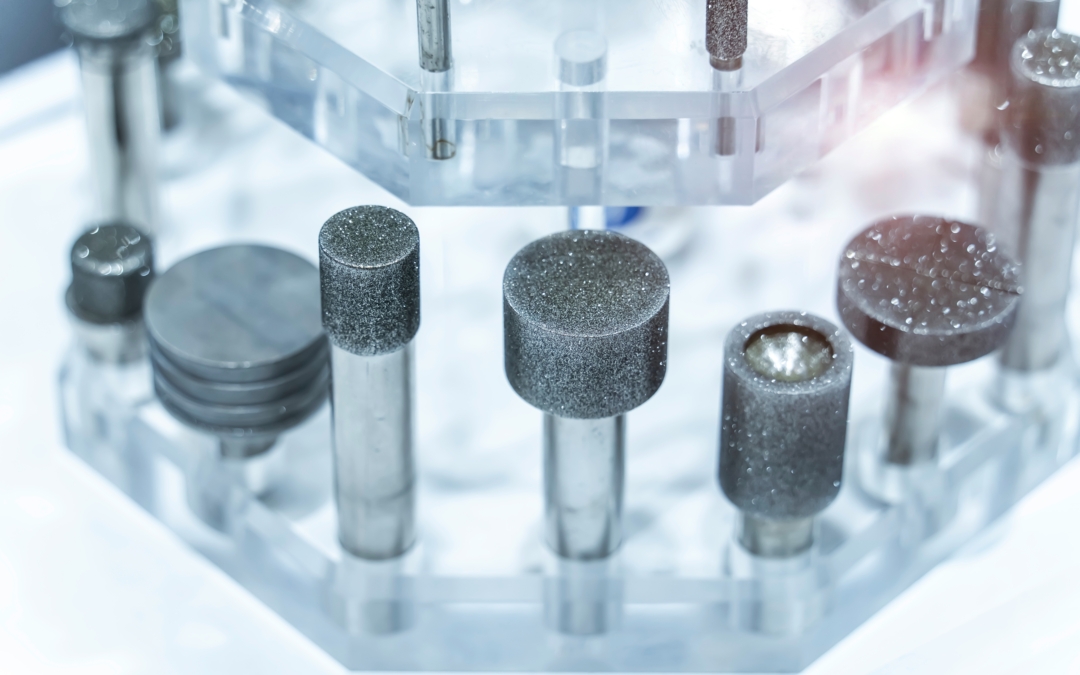
Tight Tolerance Injection Mold Polishing Services

Executive Summary
- SPI standards specify the required finish for your mold, ranging from optical clarity to structural release.
- King Precision Solutions maintains tolerances as tight as .0002 inches during the polishing process to preserve part geometry.
- Our integrated laser welding, 4 & 5 Axis vertical CNC milling, and EDM capabilities allow for seamless mold repairs and modifications under one roof.
Balancing Mold Polishing Surface Finish and Dimensional Accuracy
Injection mold polishing services must maintain critical dimensions while achieving the specified SPI grade. Polishing removes material from mold surfaces and can alter tight-tolerance features or round sharp corners. Dimensional verification throughout the process prevents these geometric changes and the part ejection failures they cause.
At King Precision, our ITAR- and ISO 9001-compliant injection mold polishing services include dimensional verification at each stage using NIST-calibrated CMM equipment and 50X microscopes to maintain tolerances within .0002 inches. Our integrated laser welding and machining capabilities eliminate multi-vendor handoffs and provide clear accountability for both surface finish and geometric integrity.
Read on to learn more about SPI grade selection and how our metrology-driven approach protects your tooling investment.
Get a Quote for Precision Injection Mold Polishing Services
How to Choose the Correct SPI Grade for Your Injection Mold
SPI standards (Society of the Plastics Industry, now the Plastics Industry Association) categorize mold finishes by their appearance and the method required to achieve them.
Comparison of SPI Standards and Applications
Different applications require specific surface roughness averages (Ra) to function correctly. For example, lens and mirror components require mirror, optical, and diamond-grade finishes to achieve optical clarity.
The table below reflects common industry SPI specifications. Actual polishing methods and abrasives vary based on material, geometry, and required tolerance control:
| SPI Grade | Finish Type | Typical Method | Application |
| A-1 | Super High Gloss | Grade #3 Diamond | Lens / Mirror / Optical |
| A-2 | High Gloss | Grade #6 Diamond | Visors / High-End Cosmetic |
| A-3 | Normal Gloss | Grade #15 Diamond | General Glossy Parts |
| B-1 | Fine Matte | 600 Grit Paper | Medium Polish / No Shine |
| B-2 | Medium Matte | 400 Grit Paper | Standard Structural Parts |
| B-3 | Medium Matte | 320 Grit Paper | Non-Cosmetic Internal Parts |
| C-1 | Fine Stone | 600 Stone | Die Cast / Thermoset |
| C-2 | Medium Stone | 400 Stone | General Industrial |
| C-3 | Coarse Stone | 320 Stone | Heavy Industrial |
| D-1 | Satin Texture | Glass Bead | Textured / Satin Feel |
| D-2 | Dull Texture | #240 Oxide | Dull / Non-Reflective |
| D-3 | Rough Texture | #24 Oxide | Rough / Grip Surface |
Selecting the Correct Finish For Your Application
Choosing a higher grade than necessary increases tooling costs and lead times, while selecting a grade that is too low may cause part ejection failures.
How King Precision Maintains Tool Tolerances While Achieving SPI Grade Finishes
We use advanced metrology equipment to verify that the polishing process improves surface finish without altering the mold’s critical dimensions.
Verifying Precision With Advanced Metrology
Accurate metrology during polishing depends on material removal rates, operator skill, and environmental conditions:
- Polishing is a subtractive process that removes material and can affect the part’s final geometry.
- King Precision Solutions employs a team with an average of 25 years of trade experience to manage this delicate process.
- Our technicians work in a climate-controlled facility with a HEPA-filtered quality lab to eliminate dust contamination.
Preventing Dimensional Failure During Finishing
Rigorous verification prevents the rounding over of sharp edges and ensures the mold cavity remains within engineering specifications.
The Advantages of Single-Source Machining and Polishing
Controlling the manufacturing process from the initial cut to the final polish results in superior accuracy and faster turnaround times.
Why Initial Surface Quality Determines Polishing Success
Standard machine shops sometimes leave deep EDM pits or mill marks on mold cavities during the initial cut. This rough surface forces polishers to remove significant material to achieve the required finish.
King Precision Solutions utilizes high-speed CNC milling and EDM to hold tight tolerances from the start. A precise initial cut allows our technicians to reach the final SPI standard without altering the part geometry.
This method minimizes the amount of material removed and preserves the integrity of the design.
Reducing the Risk of Vendor Handoff Errors
Keeping machining and polishing under one roof ensures clear accountability and prevents potential tolerance stacking issues caused by multiple vendors.
In-House Laser Welding For Mold Repair And Modification
King Precision technicians perform complex repairs and design updates internally to return tools to production faster than outsourcing allows.
Restoring Molds To Original Specifications
Injection molds inevitably suffer from parting line damage or require engineering design updates over time. King Precision Solutions technicians utilize laser welding to build up new material with minimal heat input.
Our tool room re-machines the welded surface to restore the exact original geometry. Polishers then blend the repair seamlessly into the surrounding area to match the original SPI specification.
Reducing Repair Lead Times
A typical engineering change requires shipping the mold to a welder, then a machine shop, and finally a polisher. This logistical chain adds weeks to the project timeline. King Precision Solutions performs all three steps in a single facility to return your tool to production immediately.
Additional Questions / FAQ
Q: What is the difference between SPI A-Series and B-Series finishes
A: A-Series finishes are diamond or optical grade, used for lenses and mirrors, while B-Series finishes use paper to achieve a medium polish for structural parts.
Q: Can you polish a mold without rounding the sharp edges
A: Yes, our technicians polish surfaces underneath 50X microscopes to verify that sharp corners and critical geometries are preserved.
Q: How does surface finish affect plastic part release
A: Skipping the polishing step leaves machine marks that can negatively affect the cosmetic finish and prevent the molded part from releasing correctly.
Q: What tolerances can King Precision Solutions hold during polishing
A: We verify dimensions throughout the process using high-power measuring microscopes and a calibrated CMM to hold features within .0002 inches.
Q: Do you offer mold repair services alongside polishing?
A: Yes, we provide in-house laser welding and machining to repair damaged molds before polishing them back to their required specifications.
King Precision Delivers Expert Mold Polishing Services
Injection mold polishing services must balance surface finish requirements with dimensional accuracy to produce quality plastic parts. Selecting the appropriate SPI grade and working with a provider that maintains critical tolerances throughout the polishing process ensures your molds perform as engineered.
King Precision Solutions delivers precision injection mold polishing backed by over 25 years of average trade experience and NIST-calibrated metrology equipment. Our climate-controlled facility with HEPA-filtered quality lab eliminates contamination risks during the finishing process.
Click below for a quote on your injection mold polishing project.
Get a Quote for Precision Injection Mold Polishing Services